
Lexington Mold Remediation
When water intrusion triggers fungal expansion inside your walls or crawl space, swift containment stops airborne spores from spreading. Our certified crew isolates contaminated zones, removes moisture sources, and applies medical-grade HEPA filtration to safeguard your indoor environment. We restore structural wood framing and drywall to clean, healthy standards with documented clearance.
Active backup? Call (803) 555-0130 and stop using water in the house.
Prefer to talk? (803) 555-0130
Precision Mold Abatement And Structural Drying
Our technicians specialize in identifying and eradicating hidden microbial reservoirs within residential structures.
When indoor moisture originates from plumbing bursts or roof failures, our specialists deliver comprehensive property drying and water mitigation to halt moisture spread immediately.
A pattern echoed in public discussions is that homeowners facing steep five-figure remediation estimates after plumbing leaks question whether aggressive wall demolition and gutting are truly necessary.
We prioritize surgical removal of unsalvageable drywall while cleaning and preserving sound framing whenever structural integrity allows.
Homeowners dealing with persistent musty smells after moisture events look for independent mold testing to assess spore counts without high-pressure contractor sales tactics.
Our crew relies on thermal imaging cameras and calibrated moisture meters to pinpoint active moisture intrusion points without unnecessary disruption.
How We Eradicate Microbial Contamination
Our remediation strategy combines rapid containment with proven techniques refined through severe weather and structural storm recovery to safeguard your property.
- Inspection And Moisture Assessment. We inspect structural cavities with deep probes and thermal sensors to identify every damp pocket. High crawl space humidity causes subfloor insulation to fall and saturates structural wood framing, directly attracting termite infestation and wood rot.
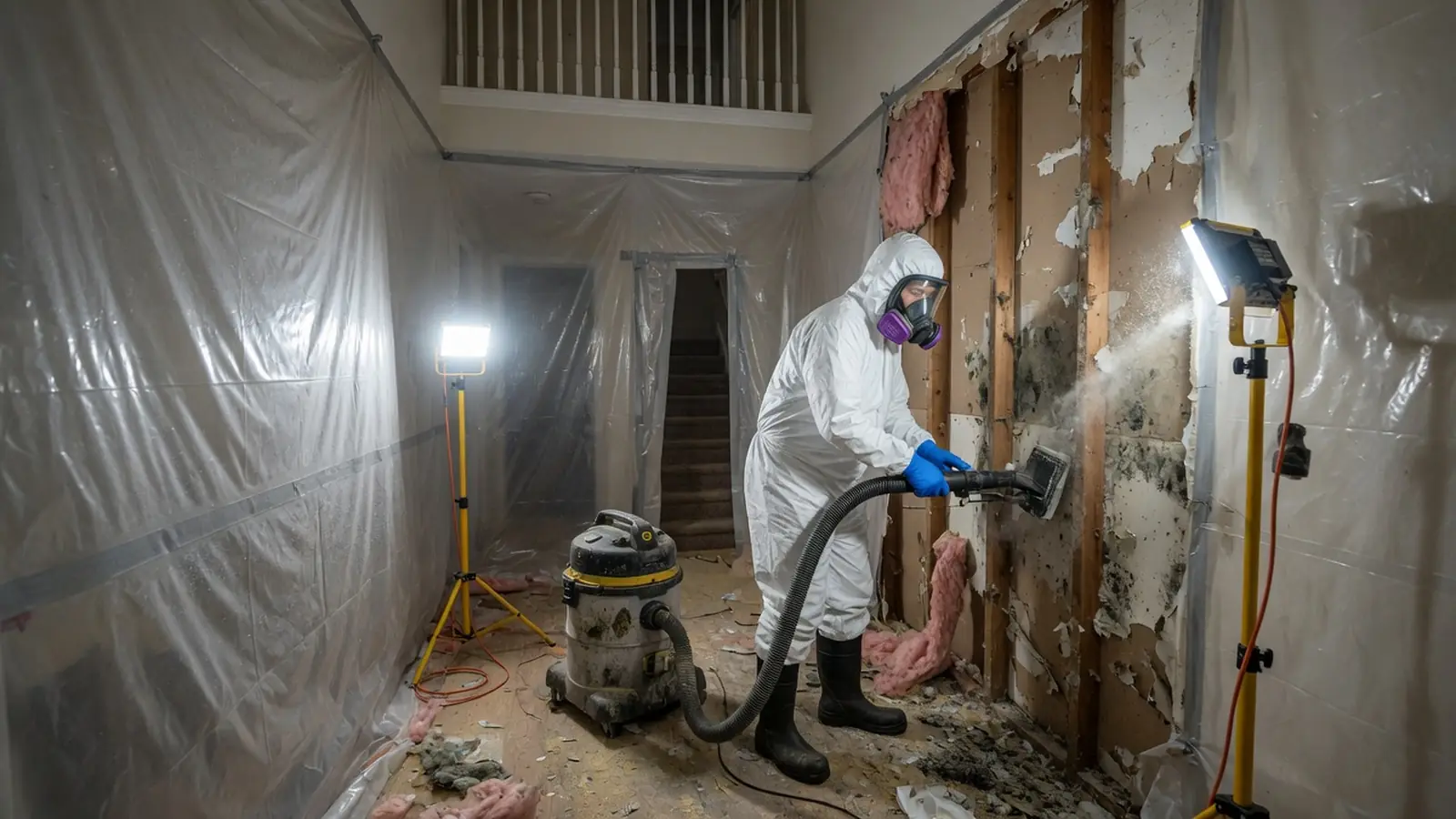
- Containment And Negative Air Setup. Remediation crews establish negative air pressure using HEPA air scrubbers inside sealed plastic containment zones before tearing out affected materials to keep mold spores from circulating. Heavy polyethylene barriers and magnetic entry doors ensure living areas remain completely isolated.
- Material Removal And Antimicrobial Cleaning. Unsalvageable drywall and saturated insulation are bagged inside containment, while structural lumber is sanded and scrubbed. We apply broad-spectrum EPA-registered antimicrobials to eliminate fungal hyphae and neutralize deep-seated wood staining.
- Deep Dehumidification And Clearance. Commercial desiccant and LGR dehumidifiers pull deep moisture from wall studs until target moisture levels are confirmed. During prolonged warm, humid months, indoor relative humidity must stay below 55 percent after drying, or dormant mold spores will re-germinate on structural framing and drywall paper.
Thorough Containment Without High-Pressure Demolition
We approach every project with transparent diagnostic proof rather than fear tactics. We address sub-structure moisture at the source by resolving standing crawl space water and saturated soil before applying long term microbial treatments. Every containment chamber undergoes pressure testing to verify zero particle leakage into occupied living spaces.
Mold Inspection And Air Testing
We evaluate indoor air quality using certified cassette sampling and direct surface swabs. Our detailed lab documentation clearly reveals spore concentrations and specific genus identification without biased sales pressure.
Attic Decking And Roof Remediation
Improper exhaust venting leads to extensive mold growth on attic roof decking, forcing homeowners to seek antimicrobial fogging and structural remediation. We correct ventilation pathways and neutralize roof sheathing contamination completely.
Subfloor And Crawl Space Abatement
Hidden subfloor mold colonization frequently masquerades as seasonal allergies until flooring removal during remodels exposes the growth. We strip affected underlayment, treat floor joists, and seal crawl space surfaces against ground moisture.
Our Commitment To Safe Indoor Environments
We adhere strictly to IICRC S520 remediation standards, utilizing calibrated diagnostic equipment and documented spore clearance protocols on every project.
- 16Zip Codes Served
- 8Service Areas
- 3Services Offered
Homeowners across the region count on our certified technicians to restore safe indoor air quality and protect their structural investments. Here is what real property owners have experienced when hiring our team for complex moisture and remediation projects.
“My elderly mother lives with us and suffers from asthma, so airborne dust was our primary concern during the duct remediation. The crew sealed every doorway with heavy plastic zipper barriers and ran negative air scrubbers continuously to keep her breathing clean air. They treated our family with immense patience and walked us through the containment zones before starting any work.”
Marcus V.
“Another contractor handed us a cut-rate estimate that completely skipped negative pressure containment and promised to spray surface chemicals instead of removing saturated baseboards. The team explained why skipping containment risks cross-contaminating unaffected bedrooms and showed us the exact spore containment protocol they use. Paying for their thorough remediation saved us from having to redo the entire master bathroom a few months later.”
Brenda K.
“Our insurance adjuster insisted on certified clearance testing and strict air quality documentation before releasing our claim funds. This company coordinated directly with the third-party industrial hygienist and provided pristine lab-verified spore counts that satisfied the inspector immediately. Having their paperwork organized down to the minute made our insurer settle without a single argument.”
Garrett S.
“Late on a Sunday evening we discovered black growth blooming behind our laundry room wall after a hidden supply valve failed. I called expecting voicemail, but their emergency dispatcher answered immediately and had technicians at our house early Monday morning to set up dehumidifiers. That prompt response prevented the moisture from spreading into our hallway hardwood flooring.”
Denise T.
Frequently Asked Questions
How do technicians verify that indoor mold growth is completely removed?
Technicians verify complete removal through rigorous visual checks, moisture mapping beneath 15 percent, and independent spore clearance testing. Air sampling compares indoor spore levels with outside baselines to verify normal fungal ecology before containment is taken down.
Can I just spray bleach on moldy wooden studs and floor joists to kill the growth myself?
Bleach cannot penetrate porous wood framing, leaving underlying fungal roots alive while the excess moisture feeds further colonization. Chlorine evaporates rapidly on surfaces, allowing moisture to soak deep into wood grain where dormant hyphae continue expanding.
Is aggressive demolition always necessary when remediating residential mold?
Aggressive demolition is unnecessary when structural framing remains sound and surfaces can be mechanically sanded, HEPA vacuumed, and treated. Homeowners facing steep five-figure remediation estimates after plumbing leaks question whether aggressive wall demolition and gutting are truly necessary, which is why we test thoroughly before removing materials.
How long does a standard residential mold remediation project take to complete?
Most residential remediation projects require two to five days to complete containment setup, physical removal, deep drying, and clearance testing. Severe infestations involving extensive crawl space timber or entire attic roof decking can take slightly longer depending on moisture levels.
What indoor relative humidity level prevents mold spores from regrowing after cleanup?
Indoor relative humidity levels must remain consistently below 55 percent to prevent dormant fungal spores from germinating on organic materials. During prolonged warm, humid months, maintaining dehumidification ensures framing and drywall remain inhospitable to fungal reproduction.